

Journal · How it works
Transport as design
The hours between the hotels are not dead time to be minimised — on the best trips they are part of the trip. Train versus driver versus flight versus ferry, and how we actually choose.
Most itineraries treat transport as the dead space between the good parts — the necessary tedium of getting from one hotel to the next, to be made as short and cheap as possible. That instinct is wrong twice over. It is wrong because the cheapest, shortest connection is often the most miserable one. And it is wrong because, designed properly, the journey between two places can be one of the things you remember most clearly about the whole trip. The transport is not the gap in the holiday. On a good itinerary it is part of the holiday, chosen as deliberately as the hotels.
There are four ways we move people between places — scenic rail, private driver, internal flight, and ferry — and each is the right answer to a different question. Knowing which is which, and getting the details inside each one correct, is a quiet and decisive part of the craft.
Scenic rail: when the journey is the destination
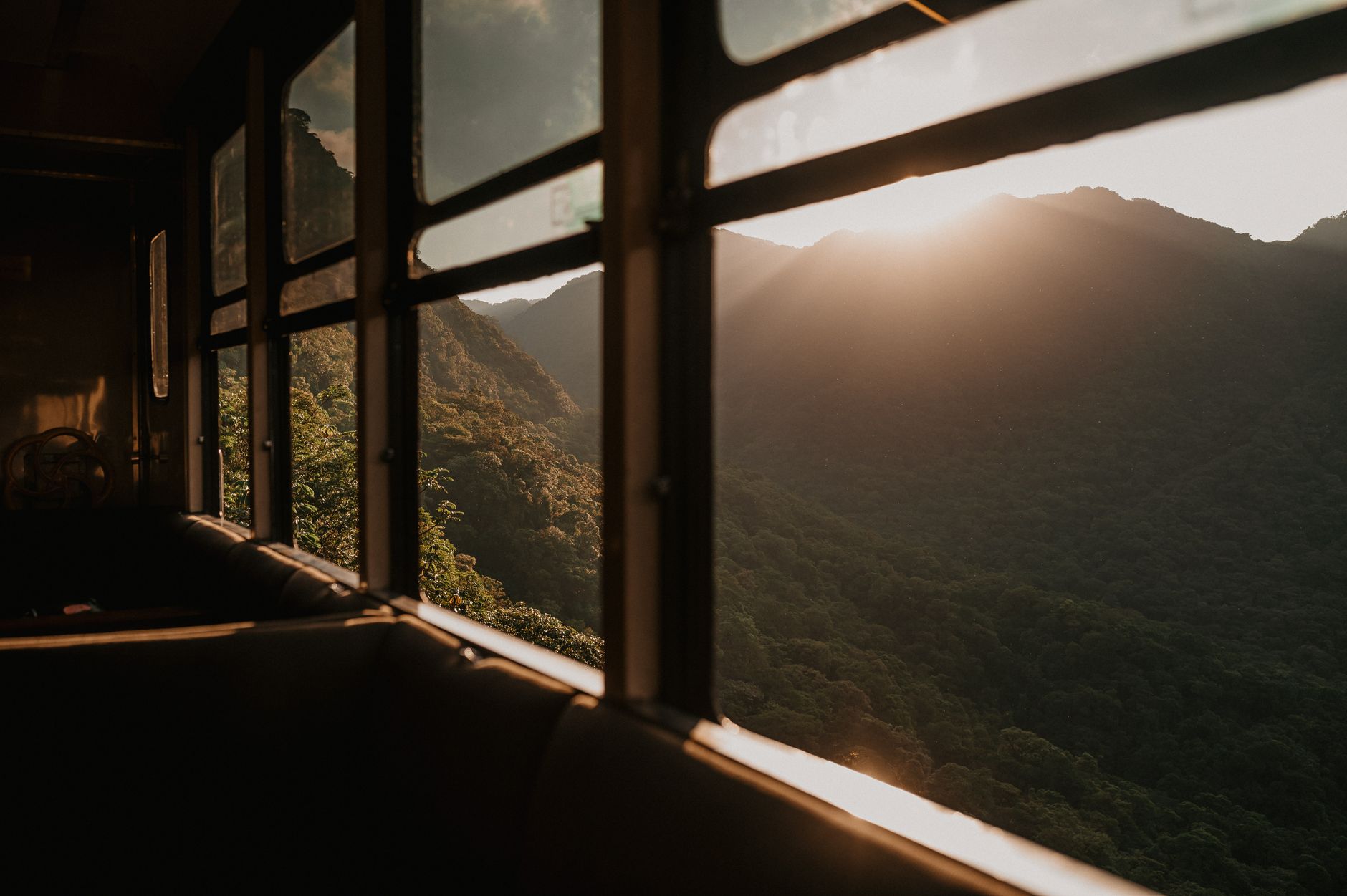
Some train journeys are transport. A few are experiences that happen to also move you, and Switzerland has the best of them. The Glacier Express runs eight hours between Zermatt and St. Moritz across 291 kilometres of the Alps, billed as the world’s slowest express, and the entire point is that it is slow. You are not getting somewhere. You are spending a day inside the scenery.
But a great train journey rewards getting the details right and punishes getting them wrong, and here the details are specific. The Glacier Express requires both a ticket and a mandatory seat reservation — they are two separate purchases, and the reservation is not optional on any fare or pass. As of 2026 the reservation is CHF 54 in first or second class. The panoramic cars sell out, and reservations open ninety-three days ahead, which is precisely the kind of window that closes while a traveller is still deciding — we book the moment it opens.
Then there is the question of class, which on this train is a real fork rather than a vanity one. First class buys wider windows and a calmer car, which matters when the windows are the entire reason you’re there. And for an occasion — an anniversary, a honeymoon, a milestone — there is Excellence Class: twenty seats arranged one-to-one so every passenger gets a guaranteed window, a five-course meal with wine pairings, champagne, a concierge who takes your bags, and a dedicated bar. It is priced like the occasion it is — CHF 540 per person for the reservation in 2026, on top of a first-class ticket — and for the right trip it is worth every franc, because it converts a transfer into the centrepiece. For most trips it is not necessary and first class is plenty. Knowing which trip is which is the job.
The transport is not the gap in the holiday. On a good itinerary it is part of the holiday, chosen as deliberately as the hotels.
Two more details that separate a smooth rail day from a fraught one. The first is luggage: Swiss rail runs a door-to-door service that moves your cases from one hotel to the next while you travel with a day bag, so you are not wrestling suitcases across a platform connection — on a scenic-rail day, this is the single best thing we arrange. The second is an honest limit worth stating plainly: the reservation system cannot reliably guarantee a forward-facing window on a specific side, because the carriages are marshalled differently on the day and no booking tool knows in advance which way your seat will face. Anyone who promises you the Matterhorn will be on your exact side for the whole route is guessing. We tell you that rather than pretend otherwise.
The pass math: when a rail pass stops paying
Rail passes are sold as automatic savings, and they used to be. They are not any more, and Japan is the clearest example of why the arithmetic has to be done fresh every time rather than assumed.
The nationwide Japan Rail Pass rose roughly seventy per cent in late 2023, and a further increase lands in October 2026 — a seven-day ordinary pass moving to ¥53,000 through overseas agents, though the official online site is holding the current ¥50,000 for now. The consequence is that the pass no longer pays for itself on the trip most people buy it for. A standard Tokyo–Kyoto–Osaka itinerary is now cheaper on individual point-to-point tickets than on the pass — and those individual tickets carry a second advantage, because they let you ride the fastest Nozomi and Mizuho bullet trains, which the base pass excludes without a paid surcharge.
The pass still wins for a specific pattern: three or more long bullet-train legs in a week, or heavy day-tripping from a single base. For most luxury itineraries — two or three cities, unhurried — point-to-point tickets are both cheaper and faster, and for the far regions a domestic flight now beats the train on both counts. The rule is simple and unglamorous: run the actual numbers for the actual route, every time, and never assume the pass is the answer because it once was. That calculation takes ten minutes and routinely saves real money, and it is exactly the kind of thing that gets skipped by a traveller booking in good faith on last year’s advice.
Ferries: romantic, scenic, and weather-exposed
A ferry between Greek islands is one of the genuine pleasures of that trip — the deck, the wind, the islands rising out of the blue. It is also the most fragile link in the chain, and the details determine whether it’s a pleasure or a problem.
The first decision is the port, because Athens has three and they are not interchangeable. Piraeus is the big central port, best if you’re overnighting in Athens. Rafina is smaller, closer to the airport, often slightly cheaper, and frequently the faster route to Mykonos — which makes it the right choice if you’re heading straight from a flight to the islands rather than into the city first. Choosing the wrong port adds an hour of transfer to a day that didn’t need it.
The second decision is the vessel. High-speed catamarans are faster but fully enclosed and notably bumpier in any wind — and the Aegean has wind. Conventional ferries are slower, far steadier, and have open decks. For anyone prone to seasickness, the slower steadier boat is not a compromise; it is the difference between a lovely crossing and a miserable one, and we route accordingly rather than defaulting to the fastest option on the timetable.
The third is seasonal, and it catches people out: many island-to-island routes simply do not run in winter. There are no direct Mykonos–Santorini sailings from roughly November to March. An itinerary that assumes a summer ferry network in April is an itinerary that strands you, and knowing which routes sleep through winter is the kind of thing that doesn’t show up until the trip is already booked.
A ferry is the most fragile link in the chain. The right port, the steadier boat, and a route that actually runs in your month are the difference between the best afternoon of the trip and the worst.
Driver versus flight: the door-to-door truth
The last fork is the everyday one: between two stops a few hundred kilometres apart, do you fly, or take a private driver, or drive the scenic route yourself? The answer turns on a single idea that travellers consistently get wrong — the difference between nominal time and door-to-door time.
A one-hour flight is never one hour. It is the flight plus two hours of airport on either side plus the transfers to and from, which makes the true cost of a “short” flight closer to half a day. A private driver, meanwhile, is door-to-door: no airport, no check-in, stops wherever you like, scenery the whole way, and your luggage simply in the boot. For legs up to three or four hours, the driver frequently beats the flight on real elapsed time and beats it comprehensively on pleasantness — and on a scenic route, the drive becomes part of the trip rather than an interruption to it.
But the calculation flips on longer legs and on certain geographies. A genuinely long haul — the far ends of a large country — is where the flight earns its airport overhead, and where insisting on a “scenic” five-hour drive becomes five hours of fatigue rather than five hours of views. The honest version of this advice is that there is no default. We count the door-to-door time for each option, weigh it against how scenic and how tiring each is, and choose per leg — which is why a single itinerary might use a private driver for one connection, a ferry for the next, and a flight for the third, each because it was genuinely the right tool for that specific stretch.
Designed, not just booked
We design the transport, we don’t just book it. The travelling days are placed and chosen with the same care as the hotels, counted in real door-to-door hours, and built — where the route allows — to be something you’d look forward to rather than endure. The Glacier Express booked in first class with the luggage sent ahead; the Japan legs run on point-to-point tickets because the pass no longer pays; the Greek crossing routed from the right port on the steadier boat in the right month; the four-hour leg given to a driver so it becomes scenery instead of an airport. None of it is glamorous to arrange. All of it is the difference between a trip that flows and a trip that lurches from one hotel to the next.
The hours between the hotels are not dead time. On the trips people remember, they are some of the best hours of all.